
admin

How to Choose the Best Cybersecurity Certification That Offers Top Career Opportunities for You

One of the rapidly growing sectors in India and the global arena is cybersecurity. Selecting an appropriate cyber security program and certification is important to both career growth, eligibility of jobs, and skills development. This guide is going to assist you to make the correct choice.

Know Your Career Stage and Goals

Begin with the analysis of your present level of career development and your aspirations.

Beginners: It is possible to start with such basic certifications as CompTIA Security+ or SSCP. Study fundamentals of network management, risk management and handling an incident.

Mid-Level Professionals: Select role based certifications such as CEH, CISA, or CISM based on your interests- penetration testing, auditing or governance.

Advanced / Leadership Roles: The highest level of certifications such as the CISSP or the CCISO demonstrate that you are capable of designing and administering enterprise security programs.

1. What Is a Cyber Security Program and Its Types?

A cyber security program is an academic or planned learning journey where cyber threats to systems, networks and data are instructed. Programs may include:

  • Network security 
  • Ethical hacking 
  • Cloud security 
  • Cybersecurity policies and compliance 
  • Digital forensics 

Such programs are either online or in a classroom, can be both short-term and long-term and can result in a certification or a degree.

2. How Long Does a Cyber Security Program Take?

The duration depends on the program type:

Program Type Duration
Short-term Certification 3–6 months
Diploma Program 6 –12 months
Bachelor’s Degree 3 –4 years
Master’s Degree 1–2 years
Online Certification Courses 2–6 months 


3. Cyber Security Certification Fees in India

Certification Approx. Cost (INR)
CEH (Certified Ethical Hacker) 50,000–1,00,000
CompTIA Security+ 25,000–40,000
CISSP 80,000–1,20,000
AWS Security Specialty 30,000–50,000
Online Cyber Security Programs 10,000–50,000

4. Top Globally Recognized Cyber Security Certifications

Some of the most respected certifications worldwide:

  • Certified Ethical Hacker (CEH) – EC-Council 
  • CISSP – ISC2 
  • CISM – ISACA 
  • CompTIA Security+ / CySA+ / PenTest+ – CompTIA 
  • OSCP – Offensive Security 

These certifications enhance employment and access to lucrative jobs such as Security Analyst, Ethical Hacker, SOC Analyst or Cloud Security Engineer.

5. Choosing the Right Cyber Security Certification for Your Career

Assess Your Career Goals:

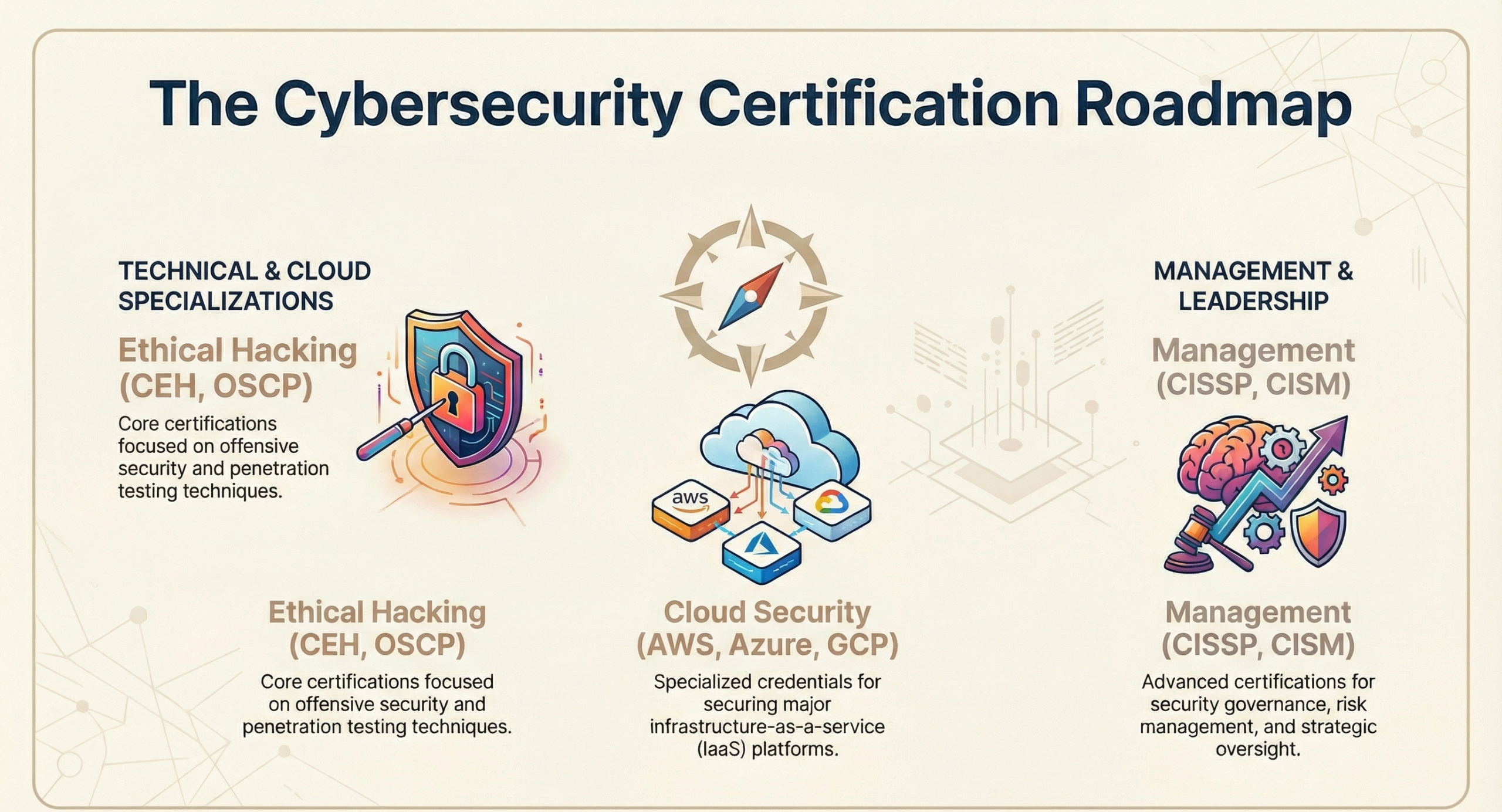
  • Ethical Hacking → CEH, OSCP
  • Cloud Security  → Cloud AWS, Azure, GCP Security.
  • Management → CISSP, CISM 

Eligibility:

  • There are certifications that necessitate work experience (CISSP: 5 years)
  • Entrap level certifications are easy to understand (Security+, CEH v12). 

Budget & Duration:

  • Take into consideration the course fees and the exam fees.
  • Courses through the internet are time and money saving

Learning Mode:

  • Classroom-based, online live, or self-paced online
  • Look for practical labs and projects 

Job Assistance / Placement:

  • Some online programs offer internships or placement support
6. Best Entry-Level Cyber Security Certifications for Freshers in India

Certification Highlights
CEH Ethical hacking fundamentals, labs, globally recognized
CompTIA Security+ Networking security, threat analysis
Certified Cybersecurity Technician (CCT) Beginner-friendly, practical skills
Google Cybersecurity Professional Certificate Online, project-based, beginner-friendly
ISC2 CC Entry-level certification for IT security beginners


FAQs

Q1. Can beginners take CEH certification?

Ans. 1 .Yes, CEH v12 is easy to use, but basic knowledge of IT is helpful.

Q2. Are cyber security certifications recognized globally?

Ans. 2.  No, such certifications as CEH, CISSP, CISM, and Security+ are worldwide accepted.

Q3. How much does a cyber security certification cost in India?

 Ans. 3   Between ₹10,000 to ₹1,20,000 depending on the certification and platform.

Q4. Can I complete a cyber security program online?

Ans. 4 Yes, there are numerous programs that are entirely online including labs, projects, and certificates.

Q5. Which is the best certification for career growth in India?

Ans. 5  CEH for ethical hacking, Security+ for beginners, CISSP/CISM for management roles, AWS Security for cloud roles.

Conclusion

The selection of an appropriate cyber security program and certification varies based on your career objectives, level of experience and budgets available and the mode of learning. CEH, Security+, and Google Cybersecurity Certificate are a good starting point among beginners. More skilled users will have an opportunity to pursue CISSP, CISM, or OSCP as well as cloud security certifications.

How to Choose the Best Cybersecurity Certification That Offers Top Career Opportunities for You Read More »

lorcam securites

CEH, OSCP, or CompTIA Security+: Which Cybersecurity Certification Is Best for You?

CEH, OSCP, or CompTIA Security+: Which Cybersecurity Certification Is Best for You?

The cybersecurity careers are at an all-time high, and with hundreds of certifications on the market, one can easily become confused. When starting out or on your next upskill, you may be wondering.

Which is the certification that will expose you to the most desirable skills, demand and employment opportunities?

Three of the most popular cybersecurity certifications are the CompTIA Security+ and Certified Ethical Hacker (CEH) certification and its Certified Ethical Hacker course and the Offensive Security Certified Professional (OSCP). This blog compares them; in doing so we will help you make the correct decision depending on your career goals and professional desires.

Career Opportunities & Salary Growth After CEH, OSCP, and CompTIA Security+

1.CompTIA Security+

Level: Beginner

Best For: Entry-level Cybersecurity Roles

Exam Type: Multiple Choice + Performance Based Questions

Focus Areas:

  • Network security
  • Threat management
  • Risk & compliance
  • Cryptography
  • Identity & access management

CompTIA Security+ is a vendor-neutral certification with a globally-recognized standard of establishing a basic knowledge of cybersecurity. It is frequently the entry level to IT professionals who are moving to positions in security.

Career Roles

  • Security Analyst
  • SOC Analyst
  • IT Security Administrator

2.Certified Ethical Hacker (CEH)

Level: Beginner to Intermediate
Best For: Ethical Hacking & Vulnerability Testing
Exam Type: Multiple Choice (Practical version available)
Focus Areas:

  • Footprinting & reconnaissance
  • System hacking
  • Malware analysis
  • Web application attacks
  • Penetration testing tools

Certified Ethical Hacker educates the way attackers think and work – legally, and in a morally sound way. Enterprise and government sectors are well aware of it.

Career Roles:

  • Ethical Hacker
  • Security Consultant
  • Vulnerability Assessor

3.Offensive Security Certified Professional (OSCP)

The Offensive Security provides the highly respected Offensive Security Certified Professional (OSCP) certification.

Level: Advanced

Best For: Penetration testers & red team professionals

Exam Type: 24-hour hands-on practical lab exam

Focus Areas:

  • Exploitation techniques
  • Privilege escalation
  • Network pivoting
  • Real-world penetration testing
  • OSCP has been ranked among the most challenging cybersecurity certifications due to its practical testing on the practical hacking skills.

Career Roles:

  • Penetration Tester
  • Red Team Operator
  • Security Researcher
Feature CEH OSCP CompTIA Security+
Target Audience Beginners/IT pros Intermediate/advanced Target Audience
Exam Format 125 MCQs (4 hrs); optional practical 24-hr hands-on lab + report Target Audience
Difficulty Moderate High Beginner-friendly
Validity 3 years (120 ECE credits) Lifetime OSCP; 3-yr OSCP+ 3 years (50 CEUs)
Avg. Salary 18–30 LPA 20- 40 LPA 05–08 LPA

CEH OSCP Security+ salary and career comparison

Before Pursuing CEH, OSCP, or CompTIA Security+: What You Should Know First

  • Basics of networking: Good knowledge of TCP/IP, network protocols, ports, as well as network topology.
  • Reacted Knowledge: Operating systems, Knowledge of windows and Linux, some command-line experience.
  • Basic Cybersecurity Ideas: Threats, vulnerabilities, risk management, firewalls, and elementary security controls.

Scripting & Automation (Recommended): Some familiarity with scripting languages, like Bash or Python, in particular useful at higher levels of certification such as OSCP.

Industry Recognition & Global Acceptance

  • CompTIA is globally recognized for vendor-neutral IT certifications.
  • EC-Council offers the Certified Ethical Hacker (CEH) certification and its Certified Ethical Hacker course is widely accepted in enterprise and government sectors.
  • Offensive Security provides Offensive Security Certified Professional (OSCP), highly respected for real-world penetration testing validation.
  • OSCP is often considered a benchmark certification for offensive security professionals.

Practical vs Theoretical Learning Approach

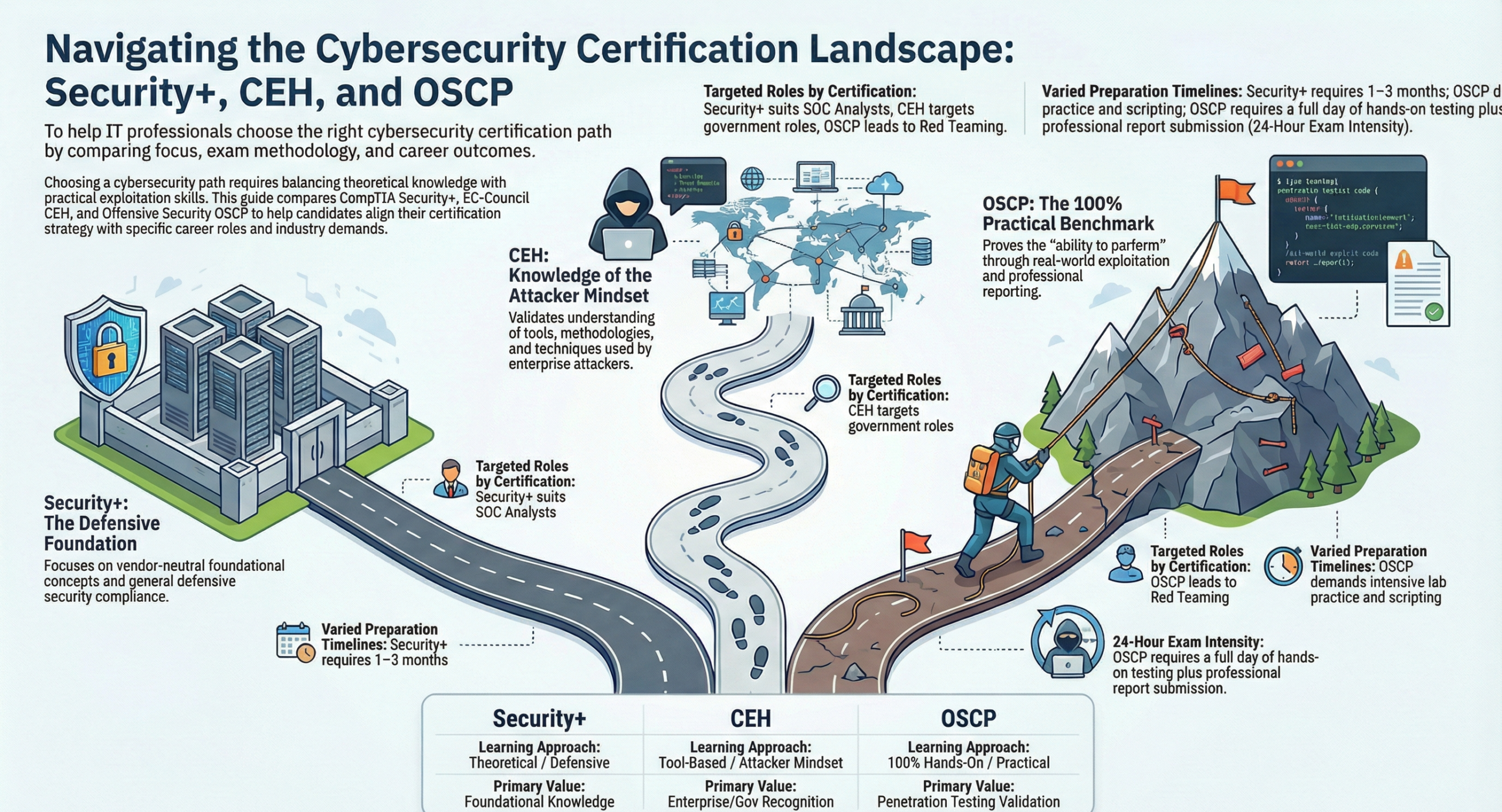
  • CompTIA Security+ is training that is based on fundamental and defensive concepts of security.
  • CEH focuses on the tools, techniques, and insights into the mindset of the attackers.
  • OSCP is entirely practical, which means that it involves actual exploitation and professional reporting.
  • OSCP is based on the ability to do, whereas CEH is on the knowledge of tools and techniques.

Career Stage & Certification Pathway

  • CompTIA Security+ is concerned with general and defensive security concepts.
  • CEH focuses on instruments, technologies, and knowledge of the mentality of the attacker.
  • OSCP is entirely practical, which requires actual exploitation and professional reporting.
  • OSCP is a certification of “ability to perform, whereas CEH is a certification of knowledge of tools and techniques.

Exam Preparation & Time Commitment

  • Security+: Foundational study (13 months typical prep).
  • CEH: Wide syllabus of various tools and methods.
  • OSCP: Intensive lab, and solving problems in the real world.
  • OSCP test has a 24-hour practical testing and a report to the profession.
  • Good Linux, networking and scripting skills required prior to OSCP.

Cost & Investment Consideration

  • Certification fees vary significantly.
  • OSCP requires lab access and longer preparation time.
  • CEH may include official training requirements.
  • Consider both financial investment and time commitment before choosing.

Employer Demand & Hiring Perspective

  • Security+ preferred for SOC Analyst and compliance-based roles.
  • CEH recognized by HR filters and government organizations.
  • OSCP highly valued for penetration testing and red team positions.
  • Practical certifications often lead to higher salary growth.
  • Experience + certification combination increases hiring chances.

Emerging Cybersecurity Trends (2025 & Beyond)

  • Growing demand for cloud security skills.
  • Increase in AI-driven cyber threats.
  • Need for real-world offensive security capabilities.
  • Organizations prefer candidates with practical lab experience.
  • In cybersecurity professions, it is important to engage in continuous learning.

Alternative & Complementary Certifications

  • Entry-level practical certification options before advanced exams.
  • Consider stepping-stone certifications before OSCP.
  • Build lab experience using platforms like Hack The Box and TryHackMe.
  • Integrate certifications and practical projects to ensure improved career development.

CEH OSCP Security+ salary and career comparison

Frequently Asked Questions (FAQ)

1. Is OSCP harder than CEH?

Yes, OSCP is more applied and practical in comparison to CEH that is more theoretical and tool based.

2. Can beginners start with CEH?

It can, though it is generally proposed that Security+ is a good fundamental first step.

3. Does certification guarantee a job?

There is no certification that can assure an employee a job but with a combination of practical skills the credibility and hiring potential is high.

4. Which certification pays the highest salary?

In most cases, OSCP-certified experts receive better pay because of the verification of a high level of skills.

5. Can I do all three certifications?

Yes, Lots of specialists begin with Security+, and move on to CEH, and finally, they want to become specialized with OSCP.

Conclusion

Another option is to choose between the CompTIA Security +, Certified Ethical Hacker (CEH) or the Offensive Security Certified Professional (OSCP) based on the knowledge you already possess, and what your career aims to achieve in the long term. If you are starting with a 

cyber security course, Security+ is one of the best courses to be taken with in order to establish a solid base. CEH is the way to understand the idea of ethical hacking, whereas OSCP is suited to the advanced level of penetration testing. Both certifications are beneficial and thus pick one depending on your talent and career orientation.

CEH, OSCP, or CompTIA Security+: Which Cybersecurity Certification Is Best for You? Read More »

What is VAPT? Guide to the Introductory Vulnerability Assessment and Penetration Testing.

VAPT stands for Vulnerability Assessment and Penetration Testing, a computer security procedure that exposes the vulnerabilities within systems, networks or applications and attempts to replicate real world attacks to evaluate defenses.

Core Definition

Vulnerability Assessment searches known vulnerabilities with automated tools, ranking vulnerabilities by severity and Penetration Testing actually uses the vulnerabilities to determine actual impact. Combined, VAPT offers remediation actionable insights as compared to standalone scans which can have false positives.

Key Process Steps

1.Vulnerability Assessment

  • Scan systems, applications, and networks
  • Identify security weaknesses
  • Classify risks (Low, Medium, High, Critical)

2.Penetration Testing

  • Simulate real-world cyberattacks
  • Measure actual security impact

3.Reporting & Remediation

  • Document findings with risk ratings

  • Provide security recommendations

  • Fix issues and perform re-testing

VAPT Career Outlook: Current Demand and Future Growth

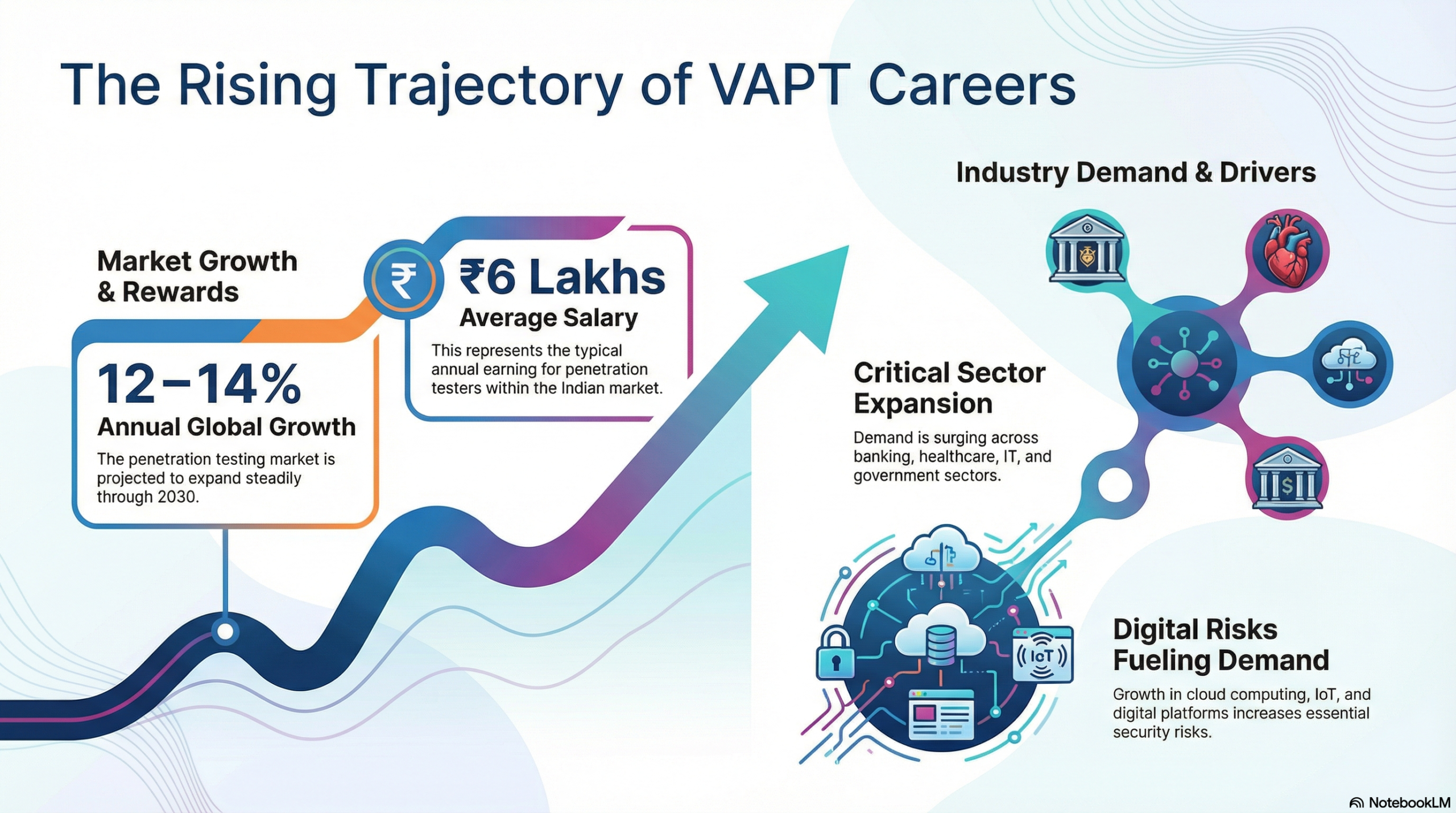
  • In India, penetration testers earn an average salary of around ₹6 lakhs per year, and demand is growing in sectors like banking, healthcare, IT, and government.
  • The global penetration testing market is expected to grow steadily (around 12–14% per year until 2030).
  • As businesses move to cloud computing, IoT devices, and digital platforms, security risks also increase.

VAPT and Penetration Testing


Top VAPT Certifications That Prioritize Hands-On Skills for 2026 Careers

Cert Provider Level Key Focus
CEH EC-Council Beginner Ethical hacking basics 
OSCP Offensive Security Advanced Real-world pentesting 
C PENT/CPENT EC-Council Advanced
CompTIA PenTest+ CompTIA Intermediate Vulnerability mgmt
GPEN GIAC/SANS Advanced Enterprise pentesting

Best tools Used in VAPT Assessment

The most important tools driving VAPT phases are Nmap and Masscan to recon and scan the network Nessus and OpenVAS detect vulnerabilities Burp Suite and OWASP ZAP test web apps Metasploit to exploit, Wireshark traffic analysis. These open-source commodities are a combination of automation and human skill (e.g., the port discovery in Nmap), which will be necessary in 2026 threats such as cloud APIs.

Top 6 Types of VAPT in Cybersecurity

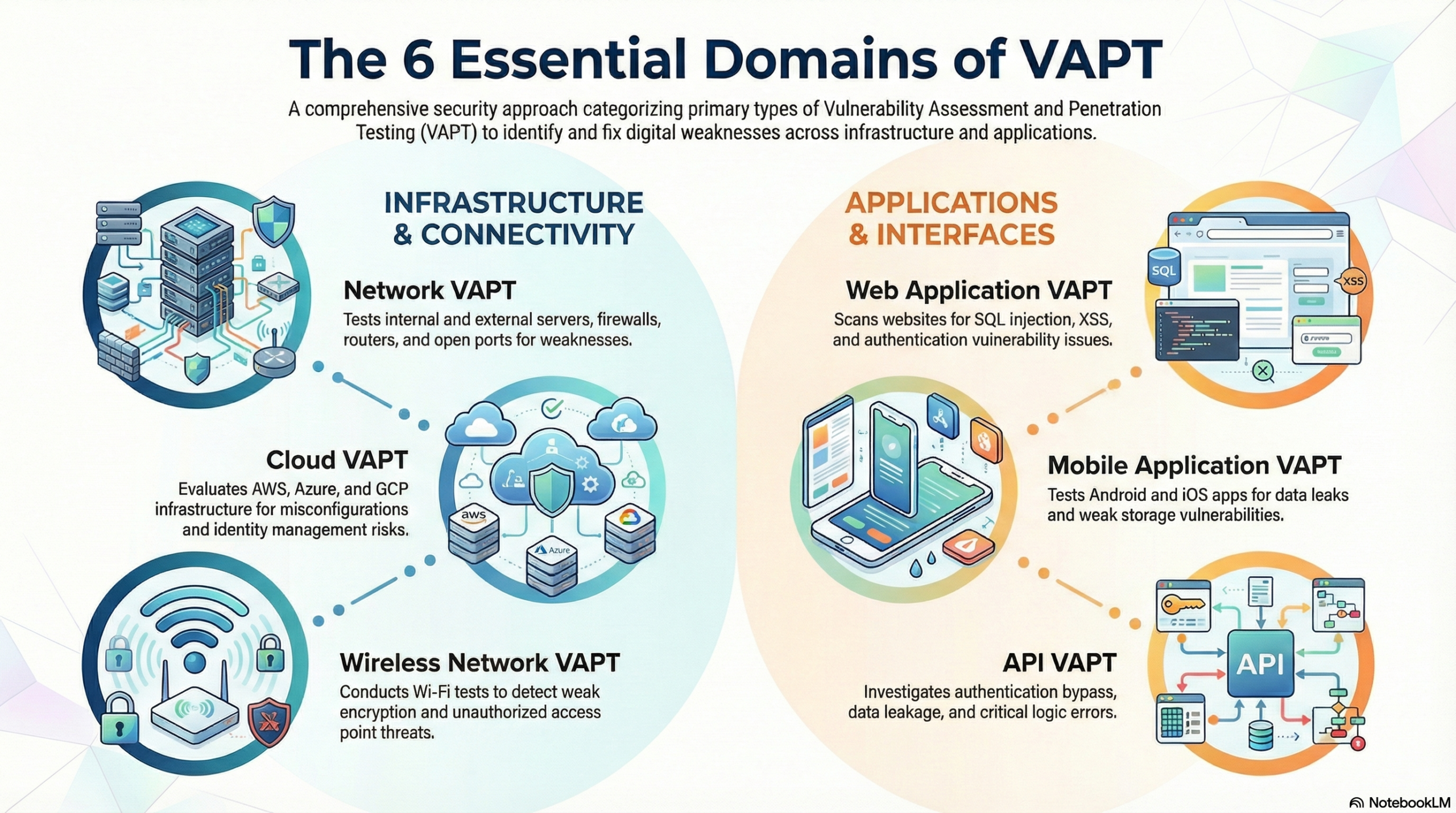
1. Network VAPT

Carries out internal and external network tests to determine the weaknesses of servers, firewalls, routers, and open ports.

2. Web Application VAPT

Scans websites and web applications due to problems such as SQL injection, XSS, authentication vulnerabilities and configuration errors.

3️. Mobile Application VAPT

Test Android and iOS applications to find out data leaks, weak storage, API vulnerability, and permissions.

4. API VAPT

Concerns itself with testing API bypass authentication, data leakage, inadequate access controls, and logic errors.

5️. Cloud VAPT

Assesses the cloud infrastructure (AWS, Azure, GCP) on misconfigurations, open storage, and identity management risks.

6. Wireless Network VAPT

Conducts Wi-Fi network tests to detect weak encryptions, unauthorized access point, and network intrusion threats.


VAPT and Penetration Testing

Roles and Responsibilities of a VAPT Professional

VAPT is a specialist such as Vulnerability Assessment and Penetration Testing and is an expert in finding vulnerabilities in the systems and APIs, as well as identifying and testing vulnerabilities in the networks and web applications. They will also conduct vulnerability tests to identify the possible threats and vulnerability penetration tests where the vulnerabilities are exploited in a safe manner to learn about their effects in practice. They are also tasked with the roles of performing analysis of security vulnerabilities, risk assessment, and making comprehensive reports with clear prescriptions of remediation. Once the fixes have been applied, they test the systems again and confirm that the vulnerabilities are addressed and instruct the technical teams to improve the overall security posture of the organization.

Frequently Asked Questions (FAQs)

Question Answer
What is the difference between Vulnerability Assessment and Penetration Testing? Vulnerability Assessment is the identification of vulnerabilities in security and Penetration Testing is the actual exploitation of the vulnerability.
How long does VAPT take? Typically 1-4 weeks based on the scope and complexity of the systems.
Is VAPT mandatory in India? Yes, it is compulsory to bank in accordance with the provisions of RBI and suggested to those companies that deal with sensitive information.

Conclusion

VAPT assists organizations to remain safeguarded against increasing cyber dangers by integrating automated tools and white hat hacking capabilities. Begin with such certifications as CEH, study such tools as Nmap and Burp Suite, and get practical experience with such laboratories as Hack The Box. VAPT professionals in India receive a ₹6-10 LPA, and a steep rise in the market is anticipated by the year 2030.

What is VAPT? Guide to the Introductory Vulnerability Assessment and Penetration Testing. Read More »

Cyber Security Institute

Top 10 Cyber Security Training Institutes in India

Daily cyber threats are on the rise and with the increase in the digital technology, digital threats also rise day by day. Banking, health, IT, and government companies are currently in need of qualified cybersecurity experts who can secure their information and systems. This has rendered Cyber Security Training Institutes extremely significant to students and the working professionals. By selecting the appropriate institute that provides an opportunity to study the practical and the most appropriate cyber security in India, you can have a safe and a prosperous career in the rapidly developing sphere.

India has a vast choice of cybersecurity training ecosystems whether you are an amateur, a working professional, or want to pursue an ethical hacker, SOC analyst, or penetration tester; there are Web-based cyber security courses in India that provide certification and practical training programs. We have listed below the Top 10 Cyber Security Training Institutes in India, which constantly provide quality training, qualified certifications, and course relevant to the Industry.

1. Lorcam Securities – Industry-Focused Cyber Security Training

Lorcam Securities has become one of the companies that have developed into the fastest-growing cybersecurity training institutions in India, with their pragmatic and industry-sensitive learning philosophy.

Lorcam Securities concentrates on unlike the traditional theory based institutes:

  • Hands-on lab training
  • Simulated cyber attacks in the real world.
  • Hacking and penetration testing modules.
  • SOC training and security training.
  • Preparation of placement assistance.
  • Online and flexible learning in the classroom.

Students receive live tools exposure, actual attack situations, and mentorship, as well as making it a very good candidate to be the best cyber security institute in India.

Address: B-28, 2nd Floor, Sector-01, Noida, Uttar Pradesh -201301

Phone: +91- 8448897649

Email: info@lorcamsecurities.com

Website: https://lorcamsecurities.com/

2 . Indian School of Ethical Hacking (ISOEH)

The ISOEH is among the renowned Cyber Security Training Institutes in India. It emphasizes practical learning and industry based training programs.Trained by skilled trainers with practical laboratories, students study ethical hacking and other highly sought-after certifications such as CEH. The institute also has real world projects, which aids the students to have practical skills.

3 . EC-Council

EC-Council is a top training institute of Cyber Security in the world. It provides more than 3000 known certifications such as Certified Ethical Hacker (CEH), Certified Network Defender (CND) and Computer Hacking Forensic Investigator (CHFI). EC-Council is a training provider in India, based on internationally recognized standards of cybersecurity training. Employers across the globe highly consider its certifications and therefore it is one of the best options to students wishing to pursue a career path that is related to cybersecurity.

4 . Koenig Solutions

Koenig Solutions is a leading Cyber Security Training Institutes in India and it has online and offline programs. Its programs include courses in ethical hacking, digital forensics, secure network design and many others. Koenig, with trained instructors and a global brand name, is a good option for students looking to get high-impact jobs in the field of cybersecurity.

5 .  National Institute of Electronics & Information Technology (NIELIT)

NIELIT is a government-operated institution, which offers certifiable cybersecurity fundamentals and advanced courses. NIELIT courses are well known to be accessible throughout India with a blend of theory and practical laboratories and are therefore ideal to both students and professionals.

6. Institute of Information Security (IIS)

The Institute of Information Security is the provider of practical cybersecurity courses in ethical hacking, incident response, and security policy management. Having the training sites in large cities, IIS focuses on the practical project work and exposure to current cyber threats – the main point of contemporary cyber training.

7. WebAsha Technologies

WebAsha Technologies has created a good reputation of practical training lab oriented training. It is particularly famous due to its ethical hacking and penetration testing courses that provide students with practical experience that is essential in the field.

8. Jigsaw Academy

Despite its worldwide reputation in data science, Jigsaw Academy has cybersecurity courses as well which combine analytical thinking and security practice. The online learning opportunities and credentials are adequate to the students who want to train flexibly according to the industry demands.

9. Craw Security

Craw Security is reputable due to its special courses on ethical hacking, network security and penetration testing. It is industry based training which is practical and has real scenario simulation and placement assistance.

10. C-DAC (Centre for Development of Advanced Computing)

C-DAC is one of the most recognised research and training institutions in India which provides courses on advanced cybersecurity and digital forensics. It has stringent programs that have been credited with more technical integration and research-based cybersecurity training.

Why Choose Cyber Security Training in India?

The need to hire talented cybersecurity experts has never been as high as with the growing pace of digitalization in India. The organizations require professionals capable of securing data, networks, and lessen the effects of cyber attacks. The benefits of Cyber Security Training in India are that in addition to enhancing technical skills, it also enhances the employment opportunities in fields such as financial, government, defense, and technology.

In India, online cyber security programs with certificates are currently available in many leading institutes so learners can be able to get quality training anywhere.

Tips Before You Enroll

  • Relevance to the curriculum: The course should include the latest issues of cloud security, IoT security, AI-based cyber defence, and SOC operations.
  • Certifications: Search and find internationally or nationally recognised certifications, such as CEH, CISSP, CompTIA Security +, and so on.
  • Practical work: It is essential to work with the real tools and simulations.

Why Lorcam Securities Stands Out Among Cyber Security Training Institutes

Lorcam Securities equips students with actual cybersecurity work experience through hands-on labs, real world simulation and expert guidance, leading them to real cybersecurity work. This has enabled it to be one of the top Cyber Security Training Institutes in India both to beginners and to advanced learners due to its practical and industry centric based approach.

Conclusion

The right training is the beginning of a successful cybersecurity career. You can opt to have a practical, hands-on education, internationally recognized programs, or you can take the flexibility of an online course, but India has plenty of good choices. The list of the 10 Best Cyber Security Training Institutes in India provided above can enable you to make the correct decision in your life.

Top 10 Cyber Security Training Institutes in India Read More »